
Youth Jiu-Jitsu turns everyday wiggles, worries, and frustration into calm problem-solving your child can actually practice.
If you’re looking into Youth Jiu-Jitsu in San Jose, you’re probably not just thinking about self-defense. Most parents we meet want something more practical day to day: better focus during homework, more self-control when emotions spike, and real resilience when life feels unfair (because, for kids, it often does).
We built our youth program around those outcomes on purpose. Jiu-jitsu is a thinking sport that rewards patience, listening, and consistency. And because it’s leverage-based, kids don’t need to be the biggest or the strongest to make progress. They need to pay attention, follow steps, and keep trying, even after a mistake.
There’s also research backing what families notice. Studies indexed in PubMed and reviews of martial arts interventions report improvements in attention, working memory, self-regulation, inhibitory control, coordination, and academic self-efficacy for kids in the elementary age range. That’s a long list, but it boils down to one thing: kids learn how to steer themselves better.
Why Youth Jiu-Jitsu Builds Focus Instead of Just Burning Energy
A lot of activities tire kids out, but focus is different. Focus means your child can direct attention, hold instructions in mind, and ignore distractions long enough to finish what matters. Youth Jiu-Jitsu supports that because class is structured around clear tasks with immediate feedback.
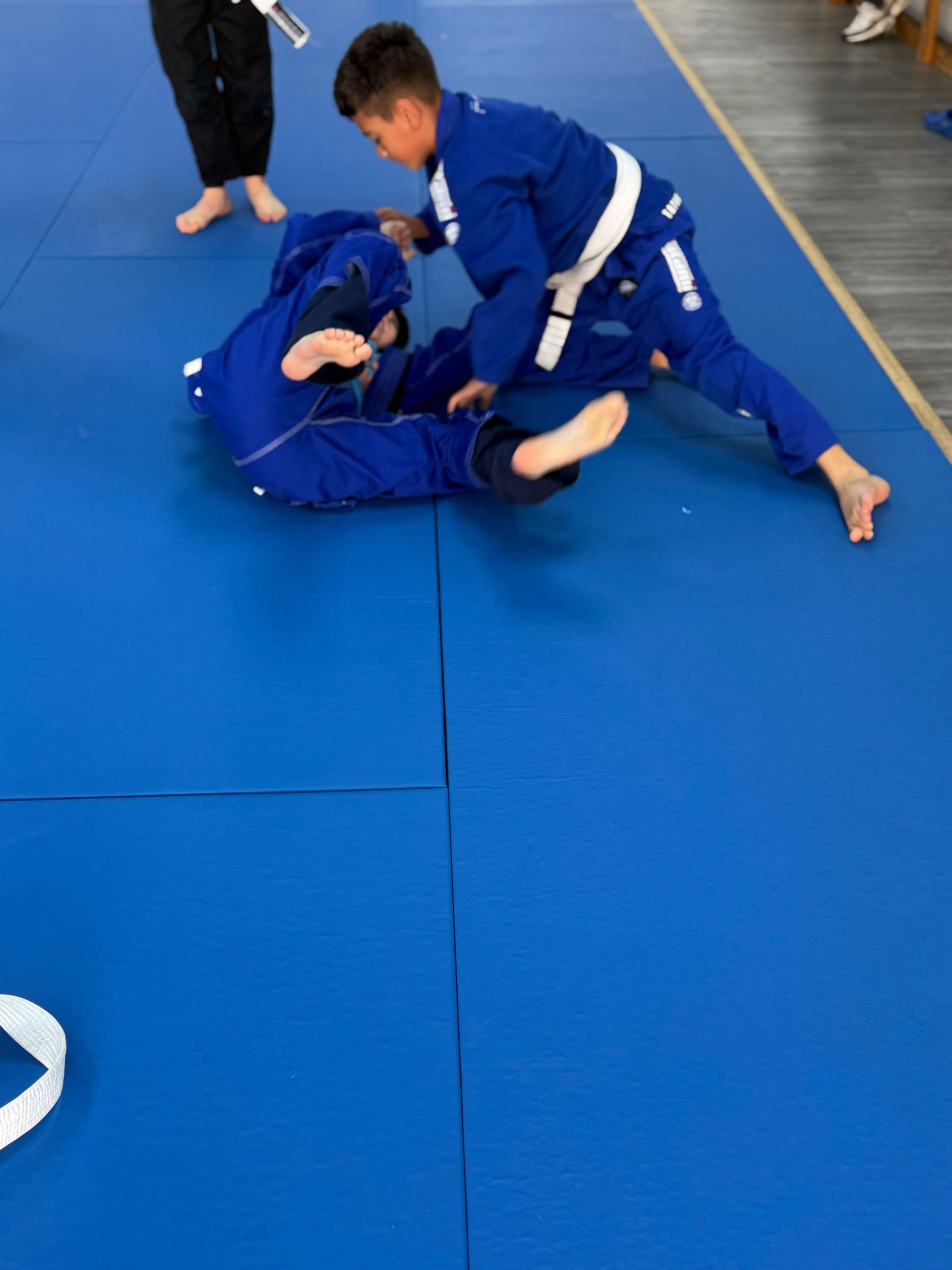
On the mat, kids practice specific movement patterns, then repeat them with a partner in a controlled way. That repetition matters. It’s the same idea as learning to read: you don’t get fluent by doing it once. You get fluent by practicing the same skills until your brain knows what to do under pressure.
Jiu-jitsu also teaches kids to notice details. Small things like where their hands are, how their hips move, and when to pause are the difference between a technique working or not. Over time, that “notice and adjust” habit becomes a focus skill your child can carry into school.
The Real Secret: Focus Comes From Better Self-Regulation
When parents tell us their child “can’t focus,” we often see something else under the surface: big feelings, fast reactions, and trouble settling after getting upset. Youth Jiu-Jitsu gives kids a safe place to practice regulating those reactions.
In class, kids learn to wait their turn, listen for cues, and stop when the coach says stop. That sounds basic, but it’s powerful practice for impulse control. Kids are learning inhibitory control without a lecture, because the environment requires it in a calm, consistent way.
A recent review of martial arts-based interventions also highlights gains in attention and self-regulation for children ages 6–12. That lines up with what we aim for: not perfection, but progress. A child who can pause, breathe, and try again is a child who can handle more of life.
Resilience Is Not “Toughness” and We Treat It That Way
Resilience is the ability to recover after something goes wrong. It’s not pretending you don’t care. It’s not pushing through pain. It’s staying calm, learning from the moment, and getting back to work.
Youth Jiu-Jitsu is full of small setbacks that are emotionally manageable and coachable. A partner escapes. A drill doesn’t work. A child forgets a step. Those moments are the training. Kids learn that mistakes are data, not drama.
We coach kids to reset quickly. We reinforce effort, good decision-making, and respectful behavior, not just “winning.” The mat becomes a place where kids learn that frustration is temporary and improvement is earned.
How Class Structure Trains the Brain to Stay On Task
Our classes aren’t random workouts. Structure is what helps kids grow, especially kids who are energetic, shy, sensitive, or easily distracted. Youth Jiu-Jitsu works best when the environment is predictable and the goals are clear.
A typical class rhythm includes instruction, drilling, controlled partner practice, and age-appropriate challenges. Kids learn to transition from listening to doing, then back to listening again. That back-and-forth is a real-world focus skill.
Because techniques connect like puzzle pieces, kids also learn sequencing. They start to understand, “If this happens, I do that.” That kind of decision tree is basically executive function training, just in a format that feels like play and progress instead of homework.
Why Leverage-Based Training Helps Kids of Different Sizes and Temperaments
One reason Youth Jiu-Jitsu is such a strong fit for kids is that it’s not built around being the biggest. Leverage, positioning, and timing let smaller students succeed, and that changes how kids see themselves.
For a shy child, success can mean learning an escape and realizing, “I can stay calm and solve it.” For a high-energy child, success can mean learning to control intensity and move with purpose instead of chaos. For a child who doubts themselves, it can mean earning a stripe through consistency, not luck.
That’s a confidence that isn’t loud. It’s steady. It shows up when your child raises their hand in class, tries a hard math problem again, or walks away from a situation that used to trigger them.
School Benefits: Attention, Listening, and Handling Frustration
Parents often ask if Youth Jiu-Jitsu helps at school. We can’t promise report-card miracles, of course, but we can explain why the training environment supports school-ready skills.
Jiu-jitsu requires kids to listen to multi-step directions, track details, and respond respectfully to correction. That maps directly to classroom behavior. Kids also get used to practicing something they’re not instantly good at, which is where a lot of school frustration comes from.
Here are a few school-related skills we see kids practice every week:
• Following instructions the first time, then asking better questions when something is unclear
• Sticking with a task for a set time, even when it feels challenging or boring
• Managing the urge to quit after a mistake, and learning how to restart
• Taking feedback without taking it personally, which is a big deal for confidence
• Using body awareness and posture that support calmer behavior at a desk or in a group
Those are simple habits, but they add up. When kids learn to stay engaged in class on the mat, it often becomes easier to stay engaged in class at school.
Anti-Bullying Skills Without Teaching Aggression
Bullying is a real concern in any city, and families in San Jose are understandably protective. Our approach to anti-bullying starts with prevention: awareness, confidence, and clear boundaries. The goal is to reduce the chance your child becomes a target and increase the chance your child can respond appropriately.
We focus on de-escalation and control. That includes posture, voice, distance management, and the ability to stay calm. If physical contact happens, we emphasize safe escapes, getting to a safer position, and seeking help, not trading punches.
Youth Jiu-Jitsu is especially useful here because it teaches kids how to control space and balance, and how to stay composed when someone is close. The deeper lesson is emotional: panic doesn’t help. A plan helps.
Age Groups, Safety, and What “Beginner-Friendly” Really Means
Parents also want to know if this is safe, especially for younger kids. Safety starts with age-appropriate coaching, clear rules, and supervision. We separate students by age and skill level so kids practice with peers who move and think at a similar pace.
Beginner-friendly does not mean we throw kids into chaos. It means we introduce fundamental movements first: base, posture, frames, and simple escapes. Kids learn how to fall safely, how to move with control, and how to partner responsibly.
If your child is brand new, we expect a learning curve. Kids need a few classes to understand the routines. That’s normal. We help them settle in, learn names, and feel comfortable asking for help.
What to Wear, How Often to Train, and How Progress Is Measured
Starting a new activity is easier when you know the basics. For Youth Jiu-Jitsu, most kids wear a gi for class, and we’ll tell you exactly what you need before you start. Keep it simple: clean uniform, trimmed nails, hair tied back, and a water bottle.
How often should your child train? Enough to build momentum, but not so much that it becomes stressful. Many families start with a consistent weekly rhythm and add days when the child is excited and ready. Consistency matters more than intensity at the beginning.
Progress is measured in small, visible steps: improved listening, better movement, calmer reactions, and skill milestones like stripes and belt advancement. We also pay attention to how your child partners. Respect and self-control are not optional in jiu-jitsu, and we treat them as real achievements.
Youth Jiu-Jitsu San Jose, CA: What a Typical Growth Path Looks Like
Youth Jiu-Jitsu San Jose, CA is most effective when you think in months, not days. The first few weeks are about comfort and routine. Kids learn class structure, basic positions, and how to move safely with a partner.
After that, you’ll usually see noticeable changes: smoother coordination, better ability to follow directions, and more patience when something is hard. Later, kids start connecting skills under light pressure. That’s where focus and resilience really show up because the child has to stay composed and make decisions.
In the long run, Jiu-Jitsu San Jose, CA becomes less about techniques and more about identity. Your child starts to see themselves as someone who can work through problems. That’s the kind of confidence that lasts.
Ready to Begin
If your main goal is a child who can focus longer, recover faster after setbacks, and handle pressure with more calm, our Youth Jiu-Jitsu program is designed for exactly that. We keep classes structured, age-appropriate, and grounded in practical habits kids can use at school, at home, and with peers.
When you’re ready, we’d love to help you map out the right starting point and class fit. That’s what we do every day at Gracie Jiu-Jitsu San Jose, and it’s why families come to us for more than “just an activity.”
If you’re curious about Jiu-Jitsu training, join a class at Gracie Jiu-Jitsu San Jose and learn with confidence.